
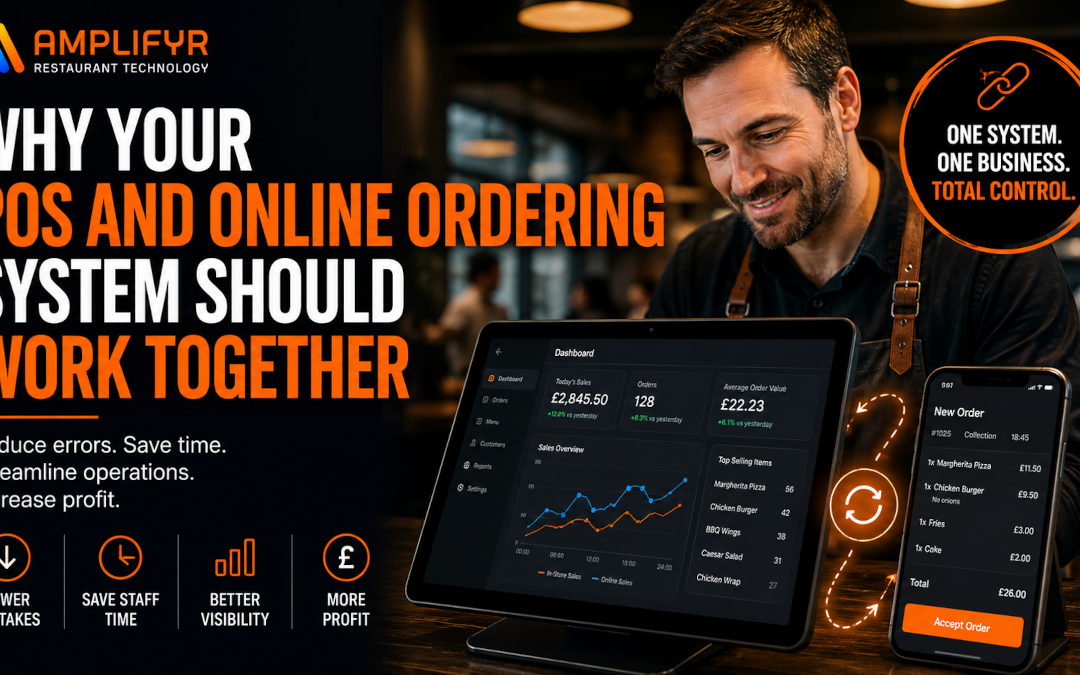
Your restaurant has one business. So why are you running separate systems to manage it?
For many restaurants and takeaways, the point-of-sale system and online ordering platform have evolved separately.
The till handles sales in-store.
The website handles online orders.
Perhaps there’s a tablet for delivery platforms, another system for payments, and separate software for reporting.
Individually, each system might work perfectly well.
But when they don’t communicate with each other, your staff end up doing the work that technology should be doing for them.
And when things get busy, that’s when the problems start.
Orders get entered incorrectly. Menus become outdated. Staff have to duplicate work. Reporting becomes more complicated. And management spends more time dealing with technology instead of running the restaurant.
An integrated POS and online ordering system can change that.
Here’s why.
What Is an Integrated POS and Online Ordering System?
An integrated system connects your restaurant’s point-of-sale system with your online ordering platform.
Instead of treating online and in-store sales as two separate operations, the systems work together.
1. A customer places an order online.
2. The order is automatically sent to your POS.
3. Your kitchen receives the information.
4. The sale is recorded.
5. Your reporting is updated.
6. And your staff don’t have to manually enter the order.
It’s a simple concept, but it can make a significant difference to how efficiently your restaurant operates.
7 Problems Caused by Disconnected Systems
Running separate systems isn’t necessarily a problem when you’re handling a small number of orders.
But as your business grows, the cracks can start to appear.

Manual Order Entry
One of the biggest problems with disconnected systems is having to manually transfer online orders into your POS.
A customer places an order online.
Someone then has to read it and enter it into another system.
That’s unnecessary work.
And every additional manual step creates another opportunity for something to go wrong.

More Order Errors
A missed modifier.
The wrong side dish.
An incorrect quantity.
A missed special request.
Small mistakes can quickly become expensive.
Not only might you have to remake the order, but you also have an unhappy customer who may not order from you again.
When orders flow directly from your online ordering system into your POS, you can significantly reduce the amount of manual input required.

Duplicate Work for Your Staff
Restaurant staff already have enough to deal with.
During a busy service, the last thing they need is to repeatedly enter information into different systems.
Disconnected technology creates unnecessary administration.
Integrated technology removes it.
That means your team can spend more time doing what actually matters: serving customers.

Your Menus Can Become Difficult to Manage
Imagine you change the price of a dish.
Or one of your ingredients becomes unavailable.
If your POS and online ordering system are separate, you may need to update multiple systems individually.
Miss one, and you’ve got a problem.
Customers could order something that’s unavailable.
Or you could end up selling an item online at the wrong price.
With an integrated system, keeping your menus and pricing aligned becomes much easier.

You Don't Get a Complete Picture of Your Sales
Your restaurant might have sales coming from:
- In-store orders
- Your website
- Collection orders
- Delivery orders
- Other ordering channels
If these sales are sitting in different systems, getting a complete picture of your business can be difficult.
How much did you actually sell yesterday?
Which products performed best?
How much came from online ordering?
What times were busiest?
Which sales channels are most profitable?
The more disconnected systems you use, the harder these questions can become to answer.
An integrated system gives you a much clearer view of what’s happening across your business.

Busy Periods Become More Difficult
This is where disconnected systems can really hurt.
A quiet Tuesday afternoon might be manageable.
But imagine Friday evening.
The phone is ringing.
Customers are queuing.
Online orders are coming through.
Delivery orders are arriving.
The kitchen is busy.
Staff are trying to keep everything moving.
That’s exactly when you don’t want your team jumping between multiple systems.
Your technology should make busy periods easier—not harder.

You're Paying for Technology That Doesn't Work Together
There’s also a financial consideration.
Restaurants can end up paying for multiple pieces of software simply because each system performs one specific job.
The problem isn’t necessarily having multiple technologies.
The problem is when those technologies don’t communicate.
The result can be more subscriptions, more administration, more training and more complexity.
Sometimes the best technology investment isn’t adding another system.
It’s connecting the systems you already need.
The Benefits of Connecting Your POS and Online Ordering
So what happens when your systems actually work together?
Orders Flow Automatically
Online orders can go directly into your POS rather than being manually re-entered.
Less admin.
Fewer opportunities for mistakes.
Your Kitchen Gets the Right Information
Orders can move through your workflow without staff having to copy information from one system to another.
That can make busy services considerably easier to manage.
Your Menu Is Easier to Control
Changes to products, prices and availability can be managed more efficiently across your ordering channels.
You Get Better Visibility
Instead of looking at several different dashboards, an integrated system gives you a clearer picture of your overall sales.
That’s valuable information when making decisions about your business.
Your Staff Save Time
Every manual task you remove gives your team more time to focus on customers and service.
And in hospitality, time is money.
What Should You Look for in an Integrated Restaurant System?
Not all integrations are created equal.
If you’re considering changing your restaurant technology, look beyond simply asking whether two systems “integrate.”
Ask how they actually work together.
Look for:
POS integration
Can online orders flow directly into your till?
Online ordering
Can customers order directly from your own website?
Collection & Delivery
Can you manage different fulfilment options?
Kitchen integration
Can orders reach the right kitchen workflow without unnecessary manual steps?
Menu management
Can you manage products, prices and availability efficiently?
Customer data
Can you build a relationship with your customers rather than simply processing transactions?
Reporting
Can you see what’s happening across your different sales channels?
Payments
Can payments be processed securely without creating unnecessary friction?
Ease of use
Can your staff actually use the system without extensive training?
Support
When something goes wrong—and occasionally it will—can you speak to someone who can help?
Does Every Restaurant Need an Integrated System?
Not necessarily.
If you’re a very small operation taking a handful of orders each day, separate systems may not cause many problems.
But as your business grows, integration becomes increasingly valuable.
The more orders you process, the more important efficiency becomes.
The more sales channels you use, the more important visibility becomes.
And the more staff you have, the more important it becomes to eliminate unnecessary manual work.
For restaurants and takeaways processing significant volumes of online orders, an integrated POS and online ordering system can become an important part of running the business efficiently.
The Real Benefit Isn’t Technology. It’s Control.
It’s easy to get caught up in features when choosing restaurant technology.
How many reports does it have?
Does it have this integration?
Does it have that feature?
But ultimately, restaurant technology should make one thing easier: running your business.
The goal isn’t to give you more software.
It’s to give you:
More control.
Fewer mistakes.
Less administration.
Better visibility.
Happier staff.
More profitable orders.
That’s what good restaurant technology should deliver.
Your POS Shouldn’t Work Against Your Online Ordering
Your online ordering system shouldn’t feel like a separate business operating alongside your restaurant.
It should be part of the same operation.
When your POS and online ordering work together, your team can spend less time moving information between systems and more time serving customers.
And management gets a clearer picture of what’s happening across the business.
That’s the real value of integration.
How Amplifyr Can Help
At Amplifyr, we help restaurants and takeaways bring their POS and online ordering together through connected restaurant technology.
Our approach is simple:
Make your technology work harder for your business.
Whether you’re replacing an existing system, moving away from a platform that’s no longer right for you, or simply wondering whether there’s a better way to manage your restaurant, we’d be happy to have a conversation.
There doesn’t need to be any hard sell.
We’ll look at how you’re currently operating, identify where your technology could be working better and show you what your options are.
Ready to Take More Control?
Book your FREE Restaurant Technology Review and discover how an integrated POS and online ordering solution could help you reduce admin, improve efficiency and keep more of every sale.
Your restaurant has one business. Your technology should work like it.